What Are the Top 10 Furniture Trends for Small Apartments?

Time:2026-09-26 Author:Sophia
0%

Small apartments reward furniture that earns its space. A sofa may need to host guests by day and open into a bed at night. A narrow dining table can double as a desk, while a storage ottoman hides blankets beneath its lid. These practical choices shape the Furniture Trends For Small Apartments covered in this guide, from modular pieces to wall-mounted storage.

The designer William Morris offered a useful standard: “Have nothing in your houses that you do not know to be useful, or believe to be beautiful.” He was not describing today’s compact-floor-plan challenges, but his words still prompt a good question: does each piece serve a purpose, bring pleasure, or both? A slim-legged chair may keep a room feeling open; a bulky cabinet can make the same corner feel crowded.

Small details matter. Measure doorways, check drawer clearance, and note where sunlight falls before choosing furniture. Looks good online. Fits badly at home. Still, flexibility has limits: a fold-down desk can feel awkward if it wobbles, and a storage bed is no help when its drawers are blocked. The ten trends ahead offer ideas, not rules. Your routines, budget, and actual floor plan should make the final call.
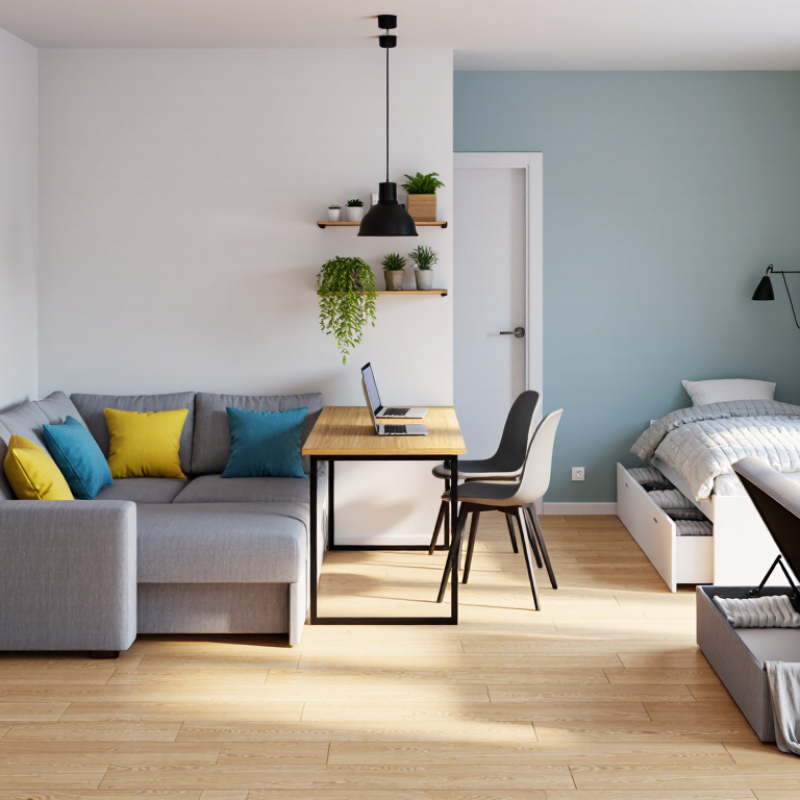
What Are the Top 10 Furniture Trends for Small Apartments?

How Small Apartments Shape Furniture Design

Small apartments do more than reduce furniture dimensions; they change how furniture must work. RentCafe’s 2024 analysis of Yardi Matrix data found that newly built U.S. apartments averaged 916 square feet in 2023, compared with 1,001 square feet in 2013. That 85-square-foot difference puts pressure on walkways, storage, and everyday routines. A sofa that blocks a closet door is not really space-saving.

Designers respond with shallower profiles, raised legs, and pieces that serve more than one purpose. A narrow console can hold keys and fold out for dinner; a bed with drawers can replace a bulky dresser. Keep pathways clear, though.

A useful rule in planning is to measure the room with doors and drawers fully open, not just the furniture footprint. Small gains matter.

Multifunctional design has limits. A dining table that takes several minutes to unfold may stay folded, while a storage ottoman can become a catch-all. Choose mechanisms you will use daily, and check that movable pieces are light enough to shift without scraping floors. Small apartments shape furniture toward flexibility, but comfort still depends on fit: seat depth, reachable storage, and room to turn matter more than squeezing in one extra feature.

Multifunctional and Convertible Furniture Trends

What Are the Top 10 Furniture Trends for Small Apartments?

Multifunctional and Convertible Furniture Trends

In a small apartment, multifunctional furniture works best when it solves a daily problem, not merely because it folds. A drop-leaf table can serve as a desk beside a window, then open for dinner. A storage ottoman keeps spare blankets close while providing a seat for guests. Small details matter: check that drawers open fully and that folded furniture still leaves a clear walkway.

Convertible sofas and wall beds are popular because they free floor space during the day. But comfort and setup matter more than clever photos suggest. Test the mattress, hinges, and locking parts before buying, if possible. Measure the room with the furniture open, not just closed. It is easy to underestimate the space a sofa bed needs. And a piece that takes several minutes to transform may stay unused on busy evenings. Simple mechanisms often win.

Tips: Measure doorways, routes, and open-bed clearance. Choose pieces you can move or operate alone. Keep frequently used items within reach; awkward storage can turn a space-saving feature into a daily annoyance.

Modular and Vertical Storage Solutions

Modular and Vertical Storage Solutions

In a small apartment, storage should grow upward without making the room feel crowded. A slim shelving tower beside the sofa can hold books, baskets, and a reading lamp. Modular units are useful because shelves, drawers, and work surfaces can be rearranged when routines change. A bench with storage can also replace a separate shoe cabinet near the door.

The U.S. Census Bureau’s 2023 American Community Survey reports an average household size of about 2.5 people nationwide. This is not an apartment-specific figure, but it underscores how shared spaces must serve different daily routines. Wall-mounted rails, tall cabinets, and stackable containers can free up floor space. Keep everyday items within easy reach, and store spare bedding higher up. Still, a tall unit can feel imposing; vertical storage is not automatically the most comfortable choice.

Tips: Measure the wall, door swing, and walking path before buying. Leave frequently used items between waist and eye level. Try one modular piece first. Live with it for a week, then adjust—some layouts look tidy but feel awkward in practice.

What Are the Top 10 Furniture Trends for Small Apartments?

Modular and vertical storage solutions lead the way in making compact homes work harder.

The bars show approximate floor space saved compared with separate, fixed-function furniture in a typical small-apartment setup. These are planning estimates, not measured survey results; actual savings depend on room layout and furniture size.

Compact, Foldable, and Expandable Designs

Compact, foldable, and expandable furniture works best when each piece solves a daily problem. The U.S. Census Bureau’s 2023 American Community Survey counted about 38 million one-person households, roughly 29% of U.S. households. For many residents, a drop-leaf table can serve as a desk by day and dining space at night. A wall-mounted folding desk clears floor space when work is done. Small changes matter.

Choose mechanisms you can operate easily, even when tired or carrying groceries. A nesting side table slides beside a sofa; a storage ottoman hides blankets without claiming another corner. For guests, a sofa bed or folding guest bed can replace a permanent spare-room setup. Measure doorways, open drawers, and walking paths before buying. A table may fit against the wall but block a cabinet when extended. That part is easy to miss.

Expandable furniture is not automatically practical. Check the weight limits, hinges, and clearance needed to open it, and test whether the folded piece has a sensible storage spot. Avoid filling every gap with a “space-saving” item; too many moving parts can make a home feel fussy. A simple, sturdy table often earns its place longer than a clever design you rarely unfold.

Choosing Furniture for Comfort and Flexibility

In a small apartment, flexible furniture should make daily routines easier, not just save floor space. A sofa bed can host an overnight guest, but test how it feels as a sofa first. Some designs sacrifice seat depth for a slim profile. Measure twice. Leave enough room to open the bed without moving half the living room.

Nesting tables work well beside a compact sofa because one can stay within reach while the others tuck away. A storage ottoman can hold blankets and serve as a footrest or extra seat. Check its height against the sofa; a mismatch can make both uses awkward. Comfort still matters. For dining, an extendable table offers room for guests, while folding chairs can hang on a wall hook when the meal is over.

Modular seating and lightweight chairs let you adjust a room for work, rest, or visitors. Pair them with a small desk that folds against the wall, but make sure its surface is deep enough for a laptop and a notebook. Keep pathways clear, especially between the entry, kitchen, and bed. One honest drawback: furniture that moves easily may feel less substantial. Sit, fold, and shift each piece before buying, if possible. A little friction is normal; constant rearranging is not a good trade.

What Are the Top 10 Furniture Trends for Small Apartments? — Choosing Furniture for Comfort and Flexibility

Trend Furniture Examples Practical Size Guide Comfort and Flexibility What to Look For
1. Multifunctional furniture Sofa beds, storage ottomans, and coffee tables with lift-up tops Choose pieces sized to the room; a compact two-seat sofa is often about 60–72 in (152–183 cm) wide. One piece can serve more than one purpose, reducing the need for extra furniture. Check the dimensions in both open and closed positions, and make sure the mechanism is easy to operate.
2. Modular seating Sectional sofas made from separate, movable units Measure each module and leave a clear path of about 30–36 in (76–91 cm) where practical. Modules can be rearranged for lounging, guests, or a new room layout. Look for secure connectors, removable covers, and modules that fit through doorways and stairwells.
3. Expandable dining tables Drop-leaf, gateleg, or extension tables A small two-person table may be about 24–30 in (61–76 cm) across; check its expanded size before buying. The table stays compact for everyday use and opens up when extra dining space is needed. Allow room to pull out chairs, and confirm that leaves or folding supports store neatly.
4. Wall-mounted desks Fold-down desks, floating work surfaces, and wall-mounted shelves A desk surface around 18–24 in (46–61 cm) deep can suit many compact work setups. Folding or floating designs free up floor area when work is finished. Secure the desk to suitable wall framing, and plan for a chair and cable management.
5. Vertical storage furniture Tall bookcases, narrow cabinets, and wall-mounted shelving For narrow spaces, consider units about 12–16 in (30–41 cm) deep, subject to storage needs. Uses wall height to add storage without spreading as far across the floor. Anchor tall units safely to the wall and keep frequently used items within easy reach.
6. Beds with built-in storage Drawer beds, lift-up storage beds, and platform beds with shelving Match the bed to the mattress size; measure the full frame, including drawers or lift-up clearance. Creates concealed storage for bedding, clothing, or seasonal items. Check drawer-opening space and whether the bed can be accessed comfortably from the available sides.
7. Lightweight, movable pieces Nesting tables, stools, folding chairs, and furniture with casters Compare the stored footprint with the expanded footprint; compact stools are often around 12–16 in (30–41 cm) wide. Easy-to-move furniture can quickly adapt a room for visitors or different activities. Choose stable frames, locking casters where needed, and pieces light enough to move safely.
8. Slim-profile furniture Armless chairs, narrow consoles, and sofas with compact arms Measure total width and depth, not just the seat; a console about 10–14 in (25–36 cm) deep may suit a narrow walkway. Provides useful seating or surfaces while preserving more open floor area. Prioritize supportive seats and sturdy construction rather than choosing solely by the smallest dimensions.
9. Room-dividing furniture Open bookcases, storage benches, and console tables used as dividers Keep divider depth proportionate to the room; many compact bookcases are roughly 10–14 in (25–36 cm) deep. Defines zones for sleeping, working, or relaxing without a permanent wall. Prefer open or low-backed designs when keeping daylight and sightlines is important; anchor tall dividers.
10. Adaptable accent pieces Storage benches, nesting side tables, and stools that double as seats Before buying, measure the available gap and check the item’s usable seat height and storage capacity. Small pieces can provide extra seating, a side surface, or hidden storage as needs change. Look for padded, supportive seating, smooth edges, and lids or surfaces that are easy to use.

Measurement note: Size ranges are practical starting points, not fixed standards. Measure doorways, walkways, and the furniture’s full footprint—including extensions, drawers, and reclined positions—before purchasing.

FAQS

How can vertical storage help in a small apartment?

A slim shelving tower can hold books, baskets, and a reading lamp beside a sofa. Keep daily items around waist-to-eye level. Tall cabinets can feel imposing, though.

What should I measure before buying modular furniture?

Measure the wall, door swing, and walking path. Check open drawers and nearby cabinets too. A piece can fit when closed but block a route when extended.

How can foldable furniture serve daily routines?

A drop-leaf table can work as a desk by day and dining space at night. A wall-mounted desk clears floor space afterward. Small changes matter.

What furniture works well for overnight guests?

A sofa bed or folding guest bed can avoid a permanent spare-room setup. Test the sofa’s comfort first. A slim profile may mean less seat depth.

How can I add storage without cluttering the room?

A storage ottoman can hold blankets and serve as a footrest or extra seat. A storage bench may replace a shoe cabinet by the door. Don’t fill every gap.

What should I check in expandable furniture?

Inspect hinges, weight limits, and the clearance needed to open it. Make sure the folded piece has a sensible storage spot. Clever isn’t always useful.

How can furniture adapt to work, rest, and visitors?

Modular seating and lightweight chairs let you change the room’s layout. Pair a folding desk with enough depth for a laptop and notebook. Keep the entry-to-kitchen path clear.

How do I know whether furniture is comfortable in practice?

Sit, fold, and shift each piece before buying, if possible. Check the ottoman’s height against the sofa. A little friction is normal; constant rearranging is not.

Conclusion

Furniture Trends For Small Apartments focus on making every square foot useful without sacrificing comfort or personal style. Because limited space calls for thoughtful choices, today’s designs often combine several functions in one piece, such as seating that provides hidden storage or tables that can adapt to different activities. Convertible furniture helps a room shift easily from relaxing to working or hosting guests, while modular pieces can be rearranged as needs change.

Vertical storage makes better use of walls and keeps valuable floor space open. Compact furniture, folding designs, and expandable surfaces offer further flexibility, providing extra capacity when needed and a smaller footprint when they are not in use. When choosing pieces, consider comfort, ease of movement, and how well each item suits everyday routines. A balanced mix of adaptable furniture and practical storage can help a small apartment feel organized, welcoming, and more spacious.

Sophia

Sophia

Sophia is a dedicated marketing professional with an exceptional depth of knowledge about her company's products and services. With a keen understanding of market trends and customer needs, she crafts insightful blog posts that not only inform but also engage readers, enriching the company’s online......